Wild Geese
You do not have to be good.
You do not have to walk on your knees
For a hundred miles through the desert, repenting.
You only have to let the soft animal of your body
love what it loves.
Tell me about despair, yours, and I will tell you mine.
Meanwhile the world goes on.
Meanwhile the sun and the clear pebbles of the rain
are moving across the landscapes,
over the prairies and the deep trees,
the mountains and the rivers.
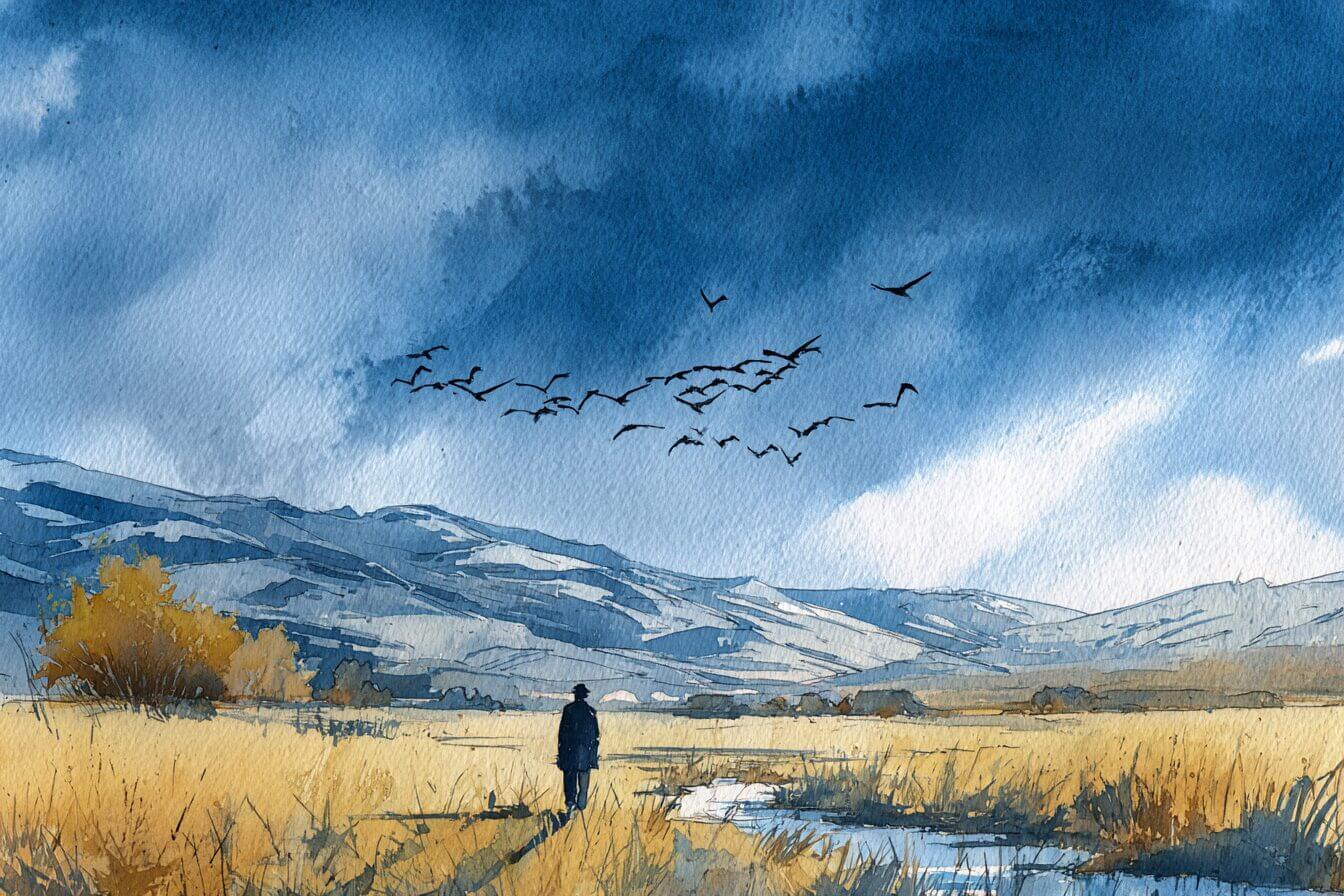
Meanwhile the wild geese, high in the clean blue air,
are heading home again.
Whoever you are, no matter how lonely,
the world offers itself to your imagination,
calls to you like the wild geese, harsh and exciting --
over and over announcing your place
in the family of things.
You can find hundreds of people online performing “Wild Geese” by Mary Oliver (1986), one of my favorites, including Helena Bonham Carter. Performances of "Wild Geese" are not few and far between; rather, recordings are posted all over the internet, with performers and audiences alike identifying with its message as it actively brings communities together into “the family of things,” making it not only a well-known but also a meaningful work of performance art. "Wild Geese" qualifies as art most convincingly through Institutionalism and Expressionism, while Formalism supports its structural power.
Institutionalism and Recognition
According to the philosophy of Institutionalism in art, a work is considered art when it is recognized by the "art world": critics, other artists, and museums. Born in 1935 and raised in a small town in Ohio, Mary Oliver developed and honed her love of nature while skipping classes and wandering through the woods with paper and pencil in hand, a Whitman book in her backpack. Perhaps it was Leaves of Grass that set her on a course like some great heroine of an epic, inspired to greatness and shaped by those who came before her.
In 1986, only two years after she won the Pulitzer Prize for Poetry for her collection American Primitive, Oliver released Dream Work, a collection including her poem “Wild Geese,” which would become one of her most notable works, praised by the art world and culture alike. Dream Work centers on the human condition, particularly in relation to nature, reflecting Oliver’s devotion to the natural world. According to Institutionalism, Oliver not only grew up inspired by a broad literary audience and poets such as Walt Whitman but also built a record of achievements that made her globally recognized as one of the greatest poets of her generation. This recognition is evident in her Pulitzer Prize and in her literature becoming a staple of the post-secondary literary canon. As mentioned earlier, the broader culture and performance world also recognize her work as great art. This institutional recognition and cultural participation make the poem not only a piece of American literature but also a work of art according to Institutionalism.
Expressionism and Emotional Sincerity
According to the philosophy of Expressionism, art must portray genuine emotion and express inner experience. The poem reflects inwardly, addressing perceptions of self in “goodness” and regret. It connects the human experience of failure with nature, transforming an isolating experience into a shared and universal one. It is also important to note that Oliver was influenced by Romanticism, including poets such as Lord Byron. In Semiotics of Performance Poetry, Arning (2023) describes modern poetry through Wordsworth’s idea of a “spontaneous outflow of powerful feelings,” suggesting that a poem’s value is assessed by emotional sincerity. This aligns with John Keats’s maxim, “truth is beauty, beauty is truth,” which connects to aesthetic philosophy and philosophical inquiry. This Romantic aspect, embodied in poetry, also reflects Expressionism, especially in performance.
Formalism and Structure
The philosophy of Formalism argues that structure and form are what make a work art. As a performance piece, "Wild Geese" demonstrates this through its construction and purpose. Because it is a literary performance, communication is integral to its structure. In its construction, the poem communicates psychological healing. It shares a broad human experience and addresses some of the most tender aspects of being human. It also expresses balance and harmony, emphasizing belonging within “the family of things.”
The poem is intentionally crafted with a specific purpose. For this reason, Formalism in "Wild Geese" is fundamental, as its structure enhances its Expressionist qualities when performed. As Robbins (2020) notes, poetry can function as a tool for catharsis and emotional cleansing when “poetic devices of symbolism and metaphor are deeply appraised in their contribution to achieving the cathartic effect.” Through public performance, poetry becomes a means of collective catharsis. The implementation of symbolism, metaphor, and essential emotional and cognitive elements can be categorized under both Expressionism and Formalism.
Rhetoric and the Soul
Plato’s view is that poetry is a form of rhetoric and that both share the same category and origin: art. For Plato, rhetoric was the craft of forming a clear, convincing, and impactful argument through skillful word choice and structure. As Dylan Thomas famously stated, a good poem helps to change the shape and significance of the universe; it helps to extend everyone’s knowledge of himself and the world around him. Therefore, it is understandable that Plato believed poetry could shape the soul. His view connects to philosophies such as Formalism, in the arrangement of speech as it relates to poetry's resemblance to rhetoric, and Expressionism, in the emotional connection between performer and audience.
Literary Layers and Interpretation
When dissecting a text and analyzing what it means, there can be multiple literary layers to discover and observe: legitimate interpretations, as well as the artist’s perspective and intention. "Wild Geese" is a great example of the many layers that can be discovered in literary and performative art. Although this text may appear to validate certain beliefs, one strong literary interpretation of the poem is this: “You are allowed to have been human.” For this reason, one can find online forums of people struggling with their humanity and finding relief in this poem.
"Wild Geese" directs the reader toward who the poem is actually for, not those seeking to downplay their past, but those willing to release harmful shame and guilt, learn from their mistakes, and recognize that failure is part of being human. It encourages the reader to say, “I do not need to have been perfect; my job is to grow.” This growth is symbolic, portrayed through nature: “the world goes on,” “the sun and the clear pebbles of the rain are moving across the landscapes, over the prairies and the deep trees, the mountains and the rivers,” (Oliver, 1986). These images offer growth as movement, something active and ongoing. Nature becomes a metaphor for “human nature.”
The Poet’s Intention vs. Radical Acceptance
There is also a strong argument for the possibility that the interpretation of “to let the soft animal inside you love what it loves” is in support of the poet’s sexual orientation, but I would argue that she leaves her poem open-ended for a reason. She leaves it open-ended so all of us can find our place in it. As Mary Oliver says in an interview with Tippett (n.d.), Oliver explained that she wanted the "I" in her poems to be the "possible reader" rather than just herself. She stated:
“That is the creative process… And that’s why, when you write a poem, you write it for anybody and everybody. And you have to be ready to do that out of your single self. It’s a giving. It’s always—it’s a gift.” (Tippett, n.d.)
Oliver was open about her sexuality, it wasn't something that she despised or “despaired” in. To call her sexuality her “despair” in the poem would be off topic. I believe there is an even stronger argument that this isn't about sexuality but rather radical acceptance.
Although some readers may take the "soft animal" line as an excuse for hedonism, it is more plausible that the writer never intended the poem to be taken that way. This poem does not argue to stop working toward goodness; rather, this poem argues to stop working toward self-destruction, self-loathing, and abusing yourself by “walking on your knees through the desert”, believing that you’re alone in your humanity, believing that you are alone in human nature. Rather, Mary Oliver wants us all to come home to the realization that we are part of something, that we are not excluded by our failures or differences, that we are a part of the “family of things.” As Mary Oliver says in the beginning, “you do not have to be good” The demand that we’re perfect now is unattainable. Rather, goodness is a direction we move toward, as we choose to feed the “soft animal inside us." Some critics argue that the poem condemns regret entirely. However, it actually supports a healthy understanding of regret, as shown in the line, “Tell me about your despair.” Despair over past behaviour is recognized and integrated into one’s self-image rather than erased.
The poem promotes humility, suggesting that moral transformation does not begin with self-erasure or self-inflicted punishment. Instead, self-annihilating guilt is portrayed as a withdrawal from life. Oliver contrasts this self-punishing stagnation with the natural world’s continual movement, implying that growth and belonging, not endless self-condemnation, are the true paths toward moral becoming.
Being vs. Becoming
The word “meanwhile” repeats throughout the poem. It creates motion independent of the reader’s paralysis in self-destruction and shame. This motion is in line with the philosophical line of questioning, Being vs. becoming, which tension is central to the ending of the poem: “Meanwhile the world goes on,” “the sun and the clear pebbles of the rain are moving…,” “the wild geese… are heading home again.” In the midst of the reader’s or hearer’s paralysis from self-punishment and shame, the world moves forward; it continues to become. While trapped in self-hatred and perfectionism, the individual is trapped in a state of being, never growing out of their failure; instead, ruminating on it, becoming alienated from nature and the world around them, further suggesting that growth and belonging are the paths toward moral becoming.
Conclusion
The poem argues against moral absolutism by challenging rigid moral fixity by implying that moral transformation is possible. As Aristotle states, “truth corresponds to reality—something either is or is not.” This idea lies at the core of philosophy: the pursuit of truth. Aristotle’s concept of potentiality, which characterizes change not only as possible but necessary for living a fulfilled and virtuous life supports Wild Geese’s claim of change in humans just as nature itself changes.
The poem is art not only because it promotes emotional healing, but also because of its structure, its formal qualities, and because of the critical recognition Mary Oliver received throughout her career. Her body of work, her Pulitzer Prize, and the way her poetry has been absorbed into communities of readers all contribute to the recognition of Wild Geese as art.
References:
Arning, C. (2023, December). Semiotics of performance poetry. Semioticon. https://semioticon.com/semiotix/2023/12/semiotics-of-performance-poetry/
Oliver, M. (1986). Dream work. Beacon Press.
Robbins, H. J. (2020, May 22). The cathartic impact of performance poetry. WordPress. https://hannahjaderobbins.wordpress.com/2020/05/22/the-cathartic-impact-of-performance-poetry/
Tippett, K. (Host). (n.d.). Mary Oliver — I got saved by the beauty of the world [Audio podcast episode]. In On Being. https://onbeing.org/programs/mary-oliver-i-got-saved-by-the-beauty-of-the-world/


Comments